
After the partial success and evolution of ‘continental drift theory’ and ‘sea floor spreading’, scientists searched for a broader and logical concept. Hence, the ‘Plate-tectonic theory’ came into existence in 1967.
Concepts like continental drift theory and sea floor spreading gave an idea about Earth’s movements, but didn’t answer every question. Hence, a better theory was needed to answer the unsolved questions.
Plate Tectonics Theory:
The term ‘Plate Tectonics’ was first coined by JT Wilson in 1965, and other independent researchers like Morgan, McKenzie, Parker, and Holmes supported this concept.
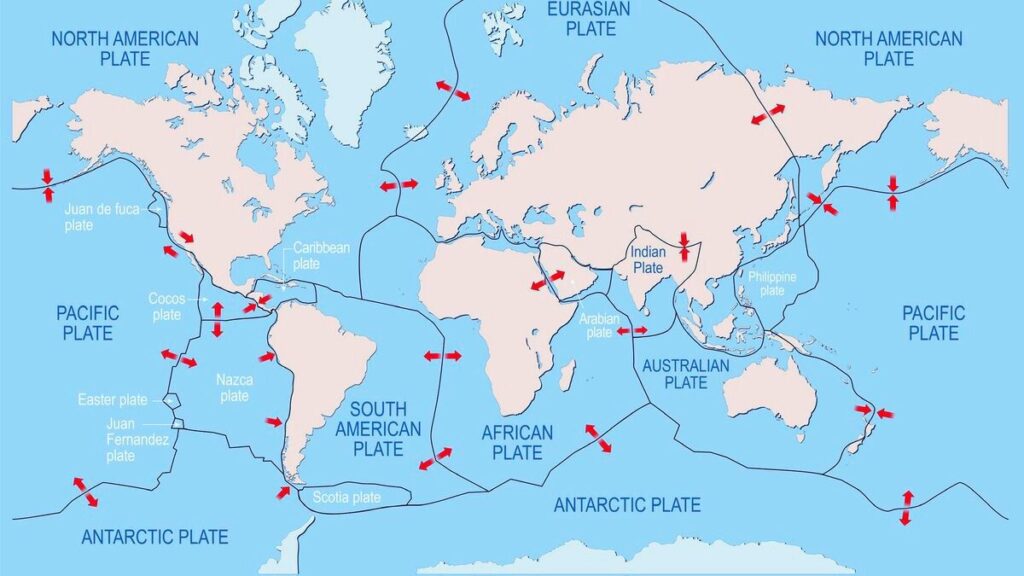
The theory explains the large-scale motions of Earth’s lithospheric movements due to major and minor tectonic plates.
Tectonic plates are massive, irregularly shaped plates or slabs of solid rock, composed of continental and oceanic lithosphere.
Earth’s lithosphere is divided into 7 major and around 20 minor plates. The thickness of continental plates can be around 200 km, whereas oceanic plates are slimmer (5-100 km thickness).
The largest oceanic plate is the Pacific plate, and the Eurasian plate is the largest continental plate. Apart from them, many other minor plates, such as the Nazca, Cocos, and Arabian plates, also exist between the major plates.
These major and minor plates move continuously and create motions with respect to each other. The paleomagnetic study of the mid-oceanic floor helps scientists determine the rate of plate movements.
Different plates have different rates of plate movements based on their size, density, and weight. The Arctic Ridge has the slowest rate (less than 2.5 cm/year), whereas the East Pacific Rise Plate is the fastest (15 cm/year). The Indian plate has a rate of plate movement of 5 cm/year.
The Force Behind Plate Tectonics:
Magmatic convection current is the primary driving force behind the plate tectonic movements. Below the rigid and static part, there is a dynamic layer that is moving continuously in a circular manner.
The heated material rises to the surface, spreads, begins to cool, and sinks into deeper depths at subduction zones at the convergent boundaries, completing the circle.
The study of rock density revealed that in mid-oceanic ridges, rocks become denser gradually, indicating the movement of plates and their evolution.
The slow movement of hot, softened mantle is termed convection flow or a cell. This convection cell is believed to be the driving force behind the plate movements.
The heat within the Earth usually comes from either radioactive decay or residual heat. This heat melts the layer and pushes the plates to move.
Plate Movements:
There are primarily three types of plate movements that create special plate boundaries or margins. On its effect, plate margins can be constructive, destructive, or conservative.
Constructive Margin or Divergent Plate Boundary:
When two different plates move away from each other, a crack develops between them from which molten lava from the asthenosphere erupts to the surface continuously and, after solidification, creates a new crust.
Hence, these types of boundaries are called divergent boundaries or constructive boundaries as a new crust is formed.
Destructive Margin or Convergent Plate Boundary:
When two plates collide with each other, the denser one is subducted below the lighter plate. The region of subduction is known as the Benioff Zone.
The plate margin is also known as the consuming margin, as the subducting plate gets lost in the mantle, and the two plates converge here.
Conservative Margin or Parallel Boundary:
When parallel plates slide past each other along a common boundary and don’t create new crust nor destroy the existing crust, but experience heavy earthquakes and the transformation of rocks.
The Rise of the Himalayas:
The Indian plate was large and heavy, situated off the Australian coast, separated from the Asian continent by a vast Tethys sea around 225 million years ago.
The Indian plate started its northward movement about 200 million years ago when Pangaea broke. About 40-50 million years ago, the Indian plate collided with the Asian plate, causing the rapid uplift of the Himalayas.
The Asian plate was lighter and got crumpled and folded to form the young Himalayas. The heavier Indian plate subducted a bit to form a trench at its foothill, which is now sedimented by plenty of rivers (now it is known as the Great Indian Plain). The process of building the Himalaya mountain is still ongoing.
Also Read: The Origin Of The Universe For SSC, Railways, & Other Competitive Examinations
Also Read: Atmospheric Layers (With Practice MCQs) For SSC, Railways, & Other Examinations

Hi, I am Lakshya Sen.. I have been teaching for SSC, Railways, and Other Examinations For 5+ years. To date, more than 1000 students have fulfilled their dreams with the help of my guidance.