
The term ‘ Stone Age’ is used to describe a period when stone was used as the most abundant material for making tools. The Stone Age started around 2-2.5 million years ago.
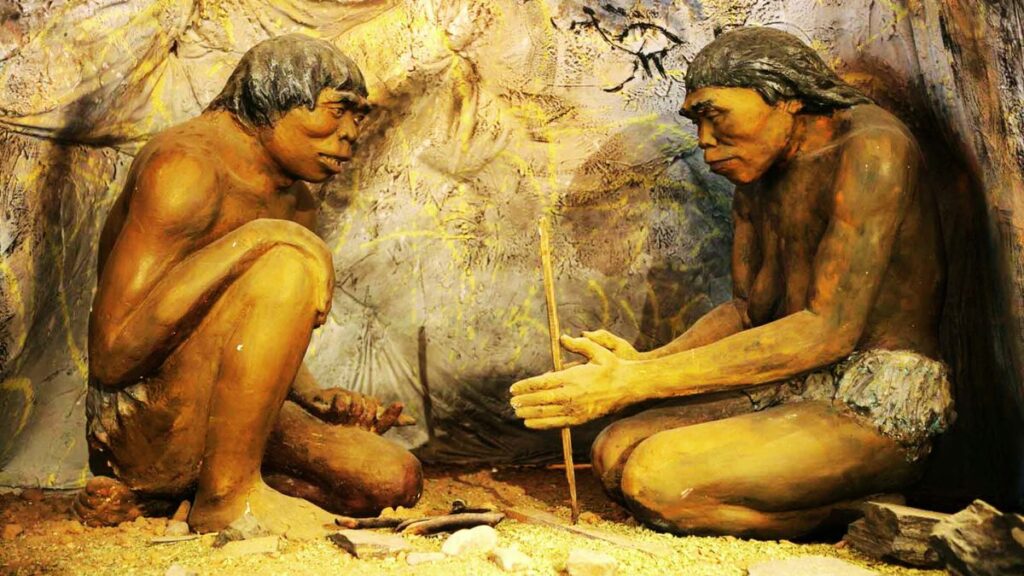
However, the transition out of the Stone Age occurred approximately 6000 BC – 2500 BC. The Stone Age is divided into three broad divisions: Palaeolithic Age, Mesolithic Age, and Neolithic Age.
The Stone Age: An Introduction
Palaeolithic Age:
This period is defined as the period of hunters and food gatherers (up to 9000 BC). The term ‘Palaeolithic’ was first coined by John Lubbock in 1865 and refers to the prehistoric era when tools were made of Quartzite. Hence, Palaeolithic people were known as Quartzite Men.
Traditionally, the Palaeolithic age is again divided into three parts: lower, middle, and upper Palaeolithic ages. Depending on the stone tools made by humans and climate change, these divisions are created.
Lower Palaeolithic Age (500000- 50000 BC):
This is the earliest subdivision of the Palaeolithic age. The tools used in this age are mainly hand axes, cleavers, choppers, and other chopping tools.
Important sites of the Lower Palaeolithic age are: Belan Valley, Bhimbetka, Bagor, Renugunta, Kurnool caves, Singbhum, and Sohan Valley.
Middle Palaeolithic Age ( 50000-40000 BC):
During this age, tools are used based on flakes and crude pebbles. The main tools used in this age are smaller than Lower Palaeolithic age. These tools are: blades, points, and borers.
Important sites during this phase are: Nevasa, Narmada Valley. Karmali Valley, Didwana, Singbhum.
Upper Palaeolithic Age ( 40000-10000 BC):
This period is characterised by burins, scrapers, the flint industry, and the appearance of modern homo sapiens.
Evidence found in the Belan Valley, Uttar Pradesh, signifies that domesticated animals like sheep, goats, and cattle were exploited during this time.
Main sites of the Upper Palaeolithic age are: Kurnool caves, Nevasa, Sabarmati Valley, Singrauli, Hungsi Valley, Pahalgam, Hathnorma, Adamgarh, and Kichler.
Mesolithic Age (9000-4000 BC):
This period is defined as the period of hunters and herders. It was known as a transitional phase between the Palaeolithic age and the Neolithic age.
The Mesolithic period is characterised and differentiated from other periods by microliths or small, pointed, sharp stone tools.
The earliest evidence of cows, horses, and other domestic animals is found in Adamgarh (Madhya Pradesh) and Bagor (Rajasthan).
Other important sites of the Mesolithic period, such as Bhimbetka, Pratapgarh, Mirzapur, Tilwara, Panch Mari, and Gauri Gundam, are known for Mesolithic art and paintings.
Neolithic Age (4000-1800 BC):
The Neolithic age is termed the period for food gatherers. It is also known as the New Stone Age, as it is the last stage of the Stone Age.
Polished stone tools and the cultivation of crops characterise the Neolithic age. The most innovations during this period were the fire and the wheel for pottery making.
Mehergarh of Pakistan is considered to be the oldest known Neolithic site in the Indian Subcontinent. However, the characteristics of the Neolithic age are as follows:
- Beginning of Agriculture
- Domestication of Animals
- Use of Polished Stone Tools
- Making of Pottery.
Kashmir was the only Neolithic site where microliths were completely absent. However, Chirand and Kashmir were the only sites where considerable bone yields were found.
In Burzahom, archaeologists discovered a dog’s grave alongside its master. Allahabad district was believed to be famous for the cultivation of rice, as many Neolithic rice husks were found in this area.
Chalcolithic Age (1800-1000 BC):
During the Chalcolithic period, tools made of copper and bronze were used as utilitarian tools. Agriculture became very prominent and advanced, and Jhum cultivation was also practised.
Many sites of the Chalcolithic age were found in the Chhota Nagpur Plateau, Ganga Basin, Narmada Basin, and Karnataka. Some of the prominent chalcolithic sites are: Ahar Banas, Kayastha, Malwa, Eran, Daimabad, and Nanyang.
Test Your Knowledge:
Also Read: Atmospheric Layers (With Practice MCQs) For SSC, Railways, & Other Examinations

Hi, I am Lakshya Sen.. I have been teaching for SSC, Railways, and Other Examinations For 5+ years. To date, more than 1000 students have fulfilled their dreams with the help of my guidance.