
The later Vedic period generally refers to the post-Rig Vedic period, especially from 1000 BC to 600 BC.
Parts of the Rig Veda (such as the 10th Mandala), Sam Veda, Yajur Veda, and Atharva Veda belong to this period.
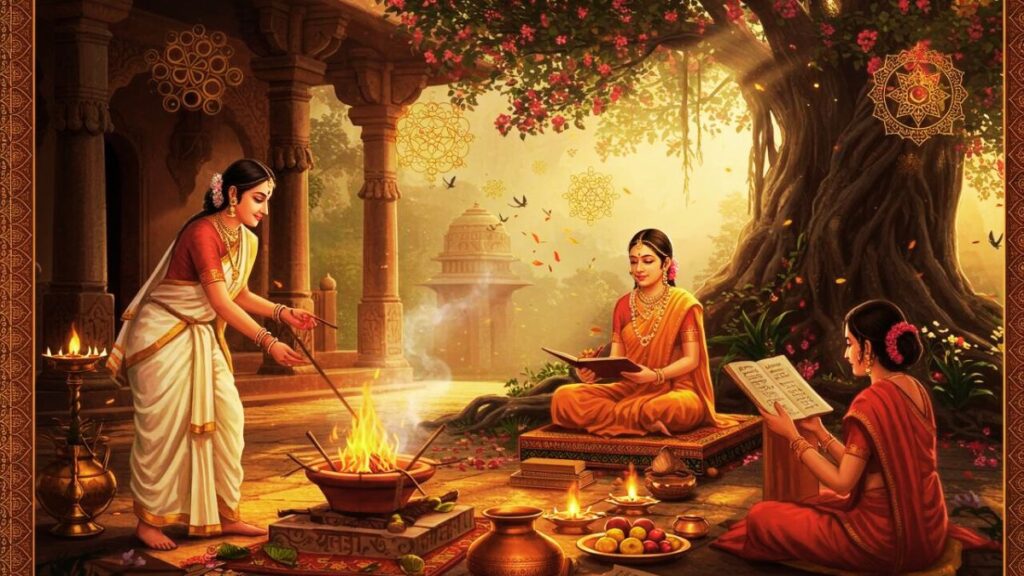
During the later Vedic period, significant changes are noticed compared to the early Vedic age.
Changes such as shifting occupation from cattle rearing to agriculture, the rise of Trinity dev, and increasing population in the Gangetic basin differ between the later Vedic age and the early Vedic age.
Later Vedic Age: The Introduction
Geography:
Unlike the early Vedic period, the Aryans shifted to the upper Gangetic doab and occupied the area. In this period, the Aryans moved to the Eastern parts, as mentioned in the story of the Vedeha Madhava in the Satpatha Brahmana.
Post-Rig Vedic literatures divide India into three broad divisions, namely, Aryavarta (North India), Madhyadesa (Central India), and Dakshina Patha (Southern India).
Political Organisation:
During the later Vedic age, kings became more powerful with the formation of larger kingdoms, known as Janapadas. His authority acquired territorial connotation.
Under the king’s control, popular assemblies lost power and importance, and nobles and brahmins largely dominated the administration.
Vedas such as the Rig and Atharva Vedas provide information about the election of the Rajan or King through the approval of the people. Taittiriya Bramhana gives the idea of the ‘Theory of Divine’ or origin of Kingship.
During the later Vedic period, five types of state systems emerged depending on the location.
| Name | Kingdom | Ruler |
| Rajya | Central | Raja |
| Bhojya | Southern | Bhoja |
| Swarajya | Western | Svarat |
| Vairajya | Northern | Virat |
| Samrajya | Eastern | Samrat |
The number of central officers increased during the later Vedic period, but a fully developed structural bureaucracy didn’t emerge. However, during this time, kings didn’t possess a standing army.
Economic Life:
The eastward movement of the Aryans towards the Gangetic valley, with the use of iron and fire, gave an impetus to the growth of agriculture.
Pastoralism or cattle rearing was not the primary occupation of the people anymore; however, they were also practised to a certain extent.
Agriculture has become the main source of income for the people. Sathpatha Bramhana describes the various stages of agriculture practised during that time, such as ploughing, sowing, reaping, and threshing.
Both kharif and rabi crops were grown during the later Vedic age. Rice (Vrihi) and wheat (Godhuma) were the main crops. Although Yava or barley was also produced during that time.
The increased importance of agriculture and land influenced the development of urban life, a new class of iron smiths, chariot makers, and shipbuilders.
Trading activities increased during this time, and coins (Satamana and Krishnala) were also used. Nishka was used as a unit of value.
The taxation system was not completely developed, as it was at a primary stage. Bali, Bhaga (the oldest tax), and Shulka were the main taxes.
- Bali: Voluntary contribution to the king.
- Bhaga: 1/6th to ½ of the produce.
- Shulka: Additional tax.
Society:
Purushasukta is a late hymn of X mandal of the Rig Veda, originating during the later Vedic period. It claims that four persons originated from the body of the Purusha or the Primaeval creator.
- Bramhana: Mouth
- Kshtriya: Arms
- Vaishya: Thighs
- Shudra: Feet.
Among them, the Brahmanas emerged as the most powerful class, and the Vaishyas were the tribute payers.
The above three varnas were allowed to be entitled Upanayana or investiture with the sacred thread, but Shudras were deprived of it and not allowed to recite the Gayatri mantra.
The institution of Gotra was established during this time, and no marriage could take place in the same Gotra.
The position of women was degraded during the later Vedic period. Their right to education, Upanayana, and participation in religious ceremonies were curbed.
Ashramas:
Ashramas were first mentioned in the Aitareya Brahmana. It was meant to regulate the life of the male member of the higher caste. Ashramas consist of four stages:
- Brahmacharya (or Student life)
- Grihasthya (or Householder)
- Vanprastha (Partial retirement)
- Sanyas (Complete retirement).
Religion:
Rig Vedic gods such as Indra, Varun, Agni, etc, lost prominence during the later Vedic age. The rise of Trinity (Brahma, Vishnu, and Rudra) filled their place.
Sacrifices become more frequent and elaborate. Priestly classes become more prestigious and wealthier. New philosophical concepts also emerged in this period.
Test Your Knowledge:

Hi, I am Lakshya Sen.. I have been teaching for SSC, Railways, and Other Examinations For 5+ years. To date, more than 1000 students have fulfilled their dreams with the help of my guidance.