Every musical instrument has its own set of requirements and skills. Musicians over the years, through hard work, mastered those skills. These exponents may be associated with orchestras, soloists or professional musicians who perform in various musical groups or ensembles.
The history of musical instruments can be traced to ancient times when people used to generate sound from natural substances such as bones, shells, and hollowed-out logs.
Later, with the development of technology, complex and modern instruments evolved. These modern instruments become more comfortable to the user as they are easy to control.
Instruments like the Sitar, tabla, and flute have gained worldwide recognition, and their exponents have also received global fame, such as Pandit Ravi Shankar, Ustad Zakir Hussain and many more.
Which Type of Questions Can You Expect From “Musical Instruments & Their Exponents”?
In recent years, especially after 2018, SSC has focused more on this topic. In every two shifts, you can find at least one straightforward question related to musical instruments and their exponents.
Most of the questions are direct, such as which personality is related to which instruments. For example:
Question: Pandit Ravi Shankar is related to which of the following instruments?
- Sitar
- Tabla
- Harmonium
- Violin
Answer: Sitar
Apart from this, questions can also be framed on Exponents.
Question: Who among the following is not associated with the Tabla?
- Ustad Zakir Hussain
- Alla Rakha Khan
- Bickram Ghosh
- Chuni Goswami
Answer: Chuni Goswami (A prominent Indian Footballer).
Additionally, you may find questions in the general intelligence (GI) sections from this topic, based on the type of instruments.
Question: Pick The Odd One Out:
- Flute
- Shehnai
- Nadaswaram
- Ghatam
Answer: Ghatam. ( Others are wind instruments, and Ghatam is a Percussion Instrument)
I hope now you can easily understand which type of questions you can find in the examinations and how you should prepare for this topic.
Maybe next time, the examiner will ask questions about the mechanism or history of musical instruments. So, let’s prepare for everything.
Type of Instruments:
According to Natya Shastra (compiled between 200 BC and 200 AD) by Bharat Muni, musical instruments were clubbed into four distinct groups:
- Avanddha vadya (membranophones or percussion instruments)
- Ghana vadya (idiophones or solid instruments)
- Sushira vadya (aerophone or wind instruments)
- Tata vadya (chordophone or stringed instruments)
Classical Music:
Indian classical music is primarily based on two different traditions, such as Carnatic music (more prevalent in South India) and Hindustani Classical music (more prevalent in North India).
| Basis Of Comparison | Carnatic Music | Hindustani Classical Music |
| Region | South India | North India |
| Number of Ragas | 72 | 6 |
| Important Instruments | Veena, Mandolin, Mridangam | Tabla, Santoor, Sitar. |
| Influenced By | Indigenous | Afgan, Persian, and Arab. |
| Focus | Both vocal and instrumental music have equal importance. | Vocal music has more importance than instrumental music. |
Wind Instruments & Their Exponents:
Wind instruments are those musical instruments in which instruments contain some kind of resonator through which a column of air is set into vibration by the player at the end of the resonator. E.g., Flute, Shehnai, Nadaswaram, Harmonium.
Harmonium:
A harmonium, also known as a reed organ or pump organ, creates sound by blowing air through reeds, which are tuned into different pitches to create musical notes.
Depending on usage, harmoniums are primarily classified into two types:
Foot-pumped harmonium:
The player presses two pedals, one at a time, with their feet. This type of harmonium was invented by Alexandre Debain (known as the inventor of the harmonium) of Paris.
Hand-pumped harmonium:
This type of harmonium is more prevalent in Southeast Asia, such as India, Bangladesh, Pakistan, and Afghanistan. Dwarakanath Ghose is known for the creation of this harmonium. It is an integral part of Sufi sangeet, Rabindra Sangeet, Qawwali, etc.
Exponents:
Purushottam Walawalkar, Appa Jalgaonkar, Jnan Prakash Ghosh.
Shehnai:
Shehnai is a double-reed woodwind instrument made of wood, in which a double reed is present at one end and a metal or wooden flared bell at the other end.
Exponents:
Bismillah Khan, Ustad Ali Ahmed Hussain Khan, Pt Anant Lal Dayashankar.
Nadaswaram:
It is the South Indian version of the Shehnai. Nadaswaram is more popular in Andhra Pradesh, Telangana, Tamil Nadu, Kerala, Karnataka, and Northeastern Sri Lanka.
Exponents:
T. N. Rajarathnam Pillai, Neeruswami Pillai.
Also Read: Sports Terminologies, Trophies, & Related Facts (20+ MCQs) For SSC & Railway Examinations
Flute:
The flute is a woodwind aerophonic instrument which produces sound when the player’s air flows across an opening. The bamboo flute has a long history in India and China.
The bamboo cross flute “Bansuri” was sacred to Krishna, the Hindu God. The person who plays the flute is known as a flautist or flutist.
Exponents:
Hari Prasad Chaurasia, Rakesh Chaurasia, Pannalal Ghosh, TR Mahalingam, Natesan Ramani.
Percussion Instruments & Their Exponents:
Percussion instruments are those musical instruments that are sounded by being struck or scraped by the beater or the player. E.g.: Ghatam, Tabla, Pakhawaj.
Tabla:
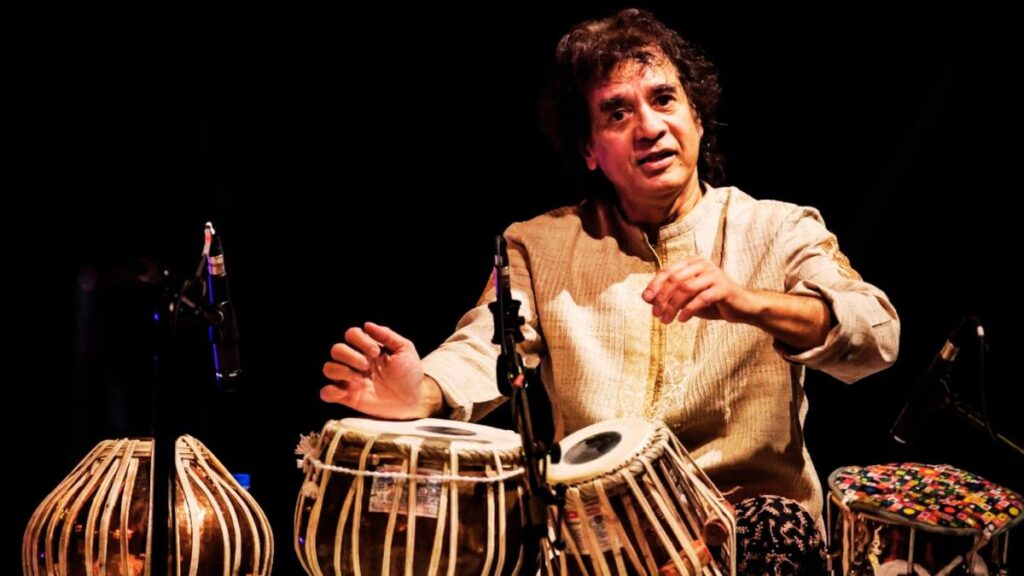
Since the 18th century, the Tabla has been an important percussion instrument in Hindustani Classical music, whether it is played solo or in groups. Tabla is a pair of hand drums, more frequently used in India, Bangladesh, Pakistan, Nepal, and Sri Lanka.
Similar to Harmonium, Tabla is an integral part of the Bhakti movement, Rabindra Sangeet, Sufi Sangeet, Qawwali, bhajan, Kirtan, and dance performances like Kathak.
Exponents:
Ustad Allah Rakha, Zakir Hussain, Pandit Kishan Maharaj, Bickram Ghosh, Pandit Satyajit Talwalkar, Fazal Qureshi.
Ghatam:
Ghatam is one of the ancient percussion instruments that looks like a gharha (earthen clay pot), mostly popular in Southern India. However, in other parts, such as Punjab, Rajasthan, and Pakistan, similar types of instruments have been used since ancient times.
Ghatams are manufactured in many places, such as Chennai and Bangalore. But, Manamadurai Ghatam (Manamadurai, a place in Tamil Nadu, known for manufacturing Ghatam) is considered superior due to its heavy, thick pot with tiny shards of brass mixed into the clay and special tonal quality.
Exponents:
TH Vinayakram (Vikku Vinayak), EM Subramaniam.
Kanjira:
It is also known as Khanjiri or ganjira, a South Indian framed drum, mainly used in folk and bhajan sangeet. Like ghatam, it is also one of the oldest musical instruments in the Indian subcontinent.
Exponents:
Pudukottai Dakshinamurthy Pillai.
Pakhawaj:
Pakhawaj is a two-headed drum that originated in the Indian subcontinent and is an essential part of the Dhrupad style of music. It is widely used in various dance forms such as Kathak, Odissi, Marathi, etc.
Exponents:
Totaram Sharma, Gopaldas, Pandit Ayodhya Prasad.
Mridangam:
Mridangam, also known as Tannumai, is a widely used ancient instrument in Carnatic music. It is considered the predecessor of the Pakhawaj used in Drupad style music.
Exponents:
SV Rajarao, KV Prasad, Palghat Mani Iyer, Palghat Raghu.
Jal Tarang:
It is a melodic percussion instrument that originates in the Indian subcontinent and consists of a set of ceramic or metal bowls filled with water.
Exponents:
Milind Tulankar, Ranjana Pradhan.
String Instruments & Their Exponents:
String instruments or chordophones are musical instruments that produce sounds when the player strums, plucks, or strikes the strings in varying manners. E.g., Guitar, Violin, Piano.
Guitar:
The guitar is a stringed musical instrument (usually has six or twelve strings) that is held flat against the player’s body and played by strumming or plucking the strings with the dominant hand while pressing selected strings with the other hand.
Guitars are divided into two categories and numerous sub-categories. The two broad categories are Acoustic guitar and Electric guitar.
Exponents:
Braj Bhushan Kabra.
Violin:
The violin, also known as the fiddle, is a wooden chordophone, the smallest yet highest-pitched instrument in the violin family. Usually, violins have a hollow wooden body with four strings (sometimes five) and a bow.
Exponents:
VG Jog, M Chandrasekharan, NR Murlidharan, MS Gopalakrishnan.
Also Read: Free Quiz On Musician & Gharana For SSC, Railway, & Other Competitive Exams
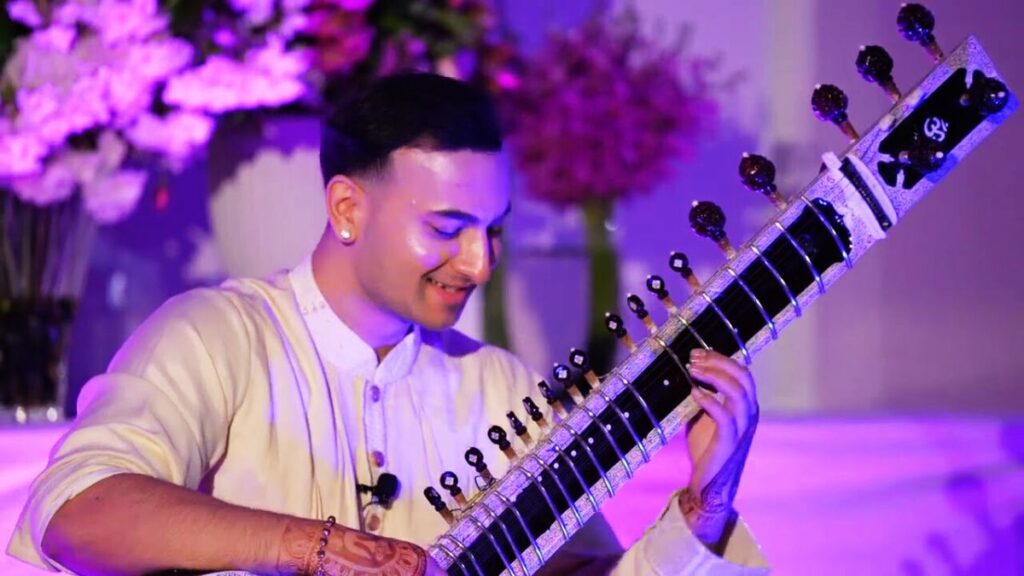
Sitar:
The sitar is a plucked string instrument that originated in the Indian subcontinent, mostly used in Hindustani Classical music. The sitar was invented in the 18th century and shaped into its modern form in the 19th century.
However, Pandit Ravi Shankar made the Sitar popular around the globe in the late 1950s and early 1960s.
Exponents:
Pandit Ravi Shankar, Anushka Shankar, Ustad Vilayat Khan, Ustad Imrat Khan, Budhaditya Mukherjee, Arvind Parikh, Rishab Rikhiram Sharma.
Sarod:
Sarod is another popular stringed instrument that is predominantly used in Hindustani music on the Indian subcontinent. This instrument is known for its deep, weighty, introspective sound and continuous slides between notes known as meend (glissandi).
Exponents:
Allauddin Khan, Ali Akbar Khan, Amjad Ali Khan, Buddhadev Dasgupta, and Bahadur Khan.
Sarangi:
The sarangi is a widely used string instrument in Hindustani Classical music. The influence of the Sarangi is more prominent in folk music in Southeast Asia.
Exponents:
Abdul Latif Khan, Ustad Binda Khan, Sultan Khan, Pandit Ram Narayan, Shakoor Khan.
Santoor:
Santoor is a famous musical instrument in Southeast Asia, mainly made of walnut wood and has 25 bridges. Each bridge contains 4 strings, which means 100 total strings. It is a traditional musical instrument in Jammu and Kashmir since ancient times.
Exponents:
Bhajan Sopori, Shiv Kumar Sharma, Tarun Bhattacharya.
Some Other String Instruments & Their Exponents:
| Instrument | Exponents |
| Mohan Veena | Pandit Vishwa Mohan Bhat (Founder of Mohan Veena) |
| Piano | V Balsara |
| Rudra Veena | Asad Ali Khan |
| Mandolin | U Srinivas, S Balamurali Krishna. |
| Surbahar | Annapurna Devi, Imrat Khan, Irshad Khan |
| Veena | Chitti Babu, S. Balachander, Doraiswamy Iyengar. |
Previous Year Questions (PYQs):
Gangubai Hangul, known for her resonant voice, specialised in the Khayal style of Hindustani classical music.
Sundaram Balachander is an Indian Veena player and filmmaker, and was honoured with Padma Bhushan in 1982.
Pandit Chatur Lal was nominated for an Oscar in 1957 for his work in the Canadian film, “A Chairy Tale”.
Also known as Drum Sivamani is a prominent percussionist who plays multiple instruments, such as Drums, Octoban, Kanjira, and Ghatam.
Ustad Amjad Ali Khan is known as ‘Sarod Samrat’ and was awarded Padma Vibhushan in 2001.
Nadaswaram.
Jal Tarang.
Damru.
Samudragupta.
Einstein started to play the Violin at just six years of age and continued it throughout his life.
Shiv Kumar Sharma.
Rajeev Janardan is a Sitar player and belongs to the Imdadkhani gharana.
Nadaswaram.
Tabla.
Pakhawaj.
Violin.
Sarangi.
Pakhawaj.
Ghatam.
Sitar.
Mridangam.
Mridangam.
Kelucharan Mohapatra.
Sarangi.
Sarod.
Bageshawri Qamar.
Veena. (He also popularised Rudra Veena.)
Sarod.
Tabla.
Surbahar.
Ghatam.
Shehnai.
Arunachal Pradesh.
West Rajasthan.
Stringed.
Manipur.
Ektara.
Surbahar.
Flute.
Harmonium.
1999.
2019.
MS Subbulakshmi.
If you like our content and effort, please share and rate us. Also, comment and suggest which topic you want to learn next.
Also Read: 19+ Musicians & Related Gharanas For SSC, Railway, & Other State Exams
Also Read: Free Quiz on Musical Instruments & Their Exponents For SSC, Railways, & Other Competitive Examinations
Hi, I am Lakshya Sen.. I have been teaching for SSC, Railways, and Other Examinations For 5+ years. To date, more than 1000 students have fulfilled their dreams with the help of my guidance.