
The universe is the sum of the potentially knowable objects, such as planets, stars, galaxies, intergalactic space, sub-atomic particles, all matter and energies. The study of the universe as a whole is called cosmology.
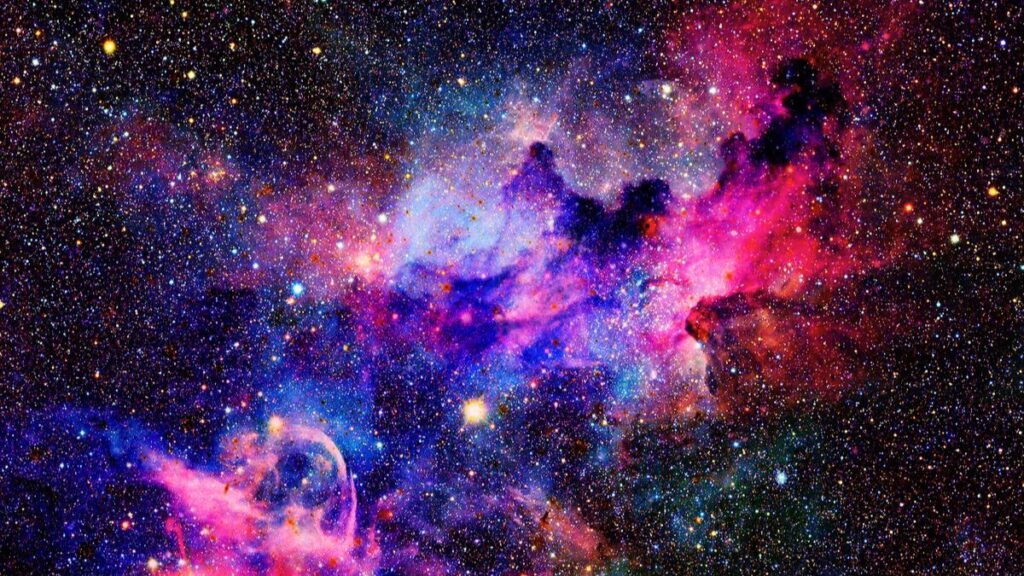
All the heavenly bodies, such as stars, plants, satellites, comets, and meteors, are known as celestial bodies, and they come together to form the universe.
The universe has been a mystery to scientists since ancient times, and numerous researchers have proposed unique theories about its origin.
The Origin of the Universe:
Early Theories:
Geocentric Theory:
The geocentric theory related to the origin of the universe was first proposed by Ptolemy in 140 AD, which states that the Earth is the centre of the universe.
Heliocentric Theory:
This is a contradictory theory of the Geocentric theory. According to the theory, the sun is the centre of the universe. This theory was proposed by Copernicus in 1543 AD.
In 1805, British astronomer Hershel studied the universe with the help of a strong telescope and claimed that the solar system is a small part of the entire universe.
Later, American astronomer Edwin Hubble stated that the diameter of the universe is 2.5 billion light-years. The universe consists of several galaxies.
Modern Theories:
There are four modern theories related to the origin and evolution of the universe that seem scientific:
Red Shift Theory:
Light is formed due to a band of colours called the spectrum. Violet colour has the shortest wavelength, whereas red light has the longest wavelength.
The movement of a star or galaxy affects the colour of light as seen by the observer. When a star approaches the observer, the light shifts to blue, and when it recedes away, it shifts to red.
Such a phenomenon is known as the Doppler effect or Doppler shift. The Doppler effect shows the observers that the universe is rapidly expanding. This astronomical observation is known as ‘Red Shift’.
Steady State Theory:
The theory was propounded by Bondi, Gold, and Fred Hoyle. According to this, the number of galaxies in the universe is constant, and new galaxies are being formed from empty space.
Hence, the overall size of the mass of the observable universe remains constant. Thus, the steady state of the universe is not disturbed at all.
Pulsating Theory:
According to this theory, the universe is supposed to be pulsating, which means expanding and contracting alternatively. Currently, the universe is expanding.
According to the Pulsating theory, the expansion of the universe may be stopped for a certain time by the gravitational pull and may contract again.
Once the universe reached a certain size, it exploded again, and the universe started expanding. The alternative expansion and contraction give rise to a pulsating universe.
Big Bang Theory:
It is the most logical and acclaimed theory related to the origin of the universe. This theory was proposed by Georges Lemaitre in the 1930s and later proved by George Gamow.
At the beginning, all the matter forming the universe was squeezed in a tiny place in the form of a tiny ball (singular or primordial atom) with unimaginably small volume, indefinite temperature and density.
Around 15 billion years ago, a major explosion occurred, and the singular atom disintegrated, giving rise to space and time. The expansion is still going on and will be ongoing.
The expansion of matter further created galaxies, and over time, these galaxies expand and move away from each other at an accelerated velocity, cooling the universe in the process.
The legality of the Big Bang theory was proven by the discovery of the Cosmic Microwave Background Radiation (CMBR) and the Wilkinson Microwave Anisotropy Probe (WMAP).
Also Read: Distribution of Minerals in India for SSC, Railways, & Other Examinations
Also Read: Plate Tectonic Theory For SSC, Railways, & Competitive Examinations

Hi, I am Lakshya Sen.. I have been teaching for SSC, Railways, and Other Examinations For 5+ years. To date, more than 1000 students have fulfilled their dreams with the help of my guidance.