
We come to know that the history of the Vedic age is largely known through the religious texts, especially the Vedas, which gave the period its name, “The Vedic Age”.
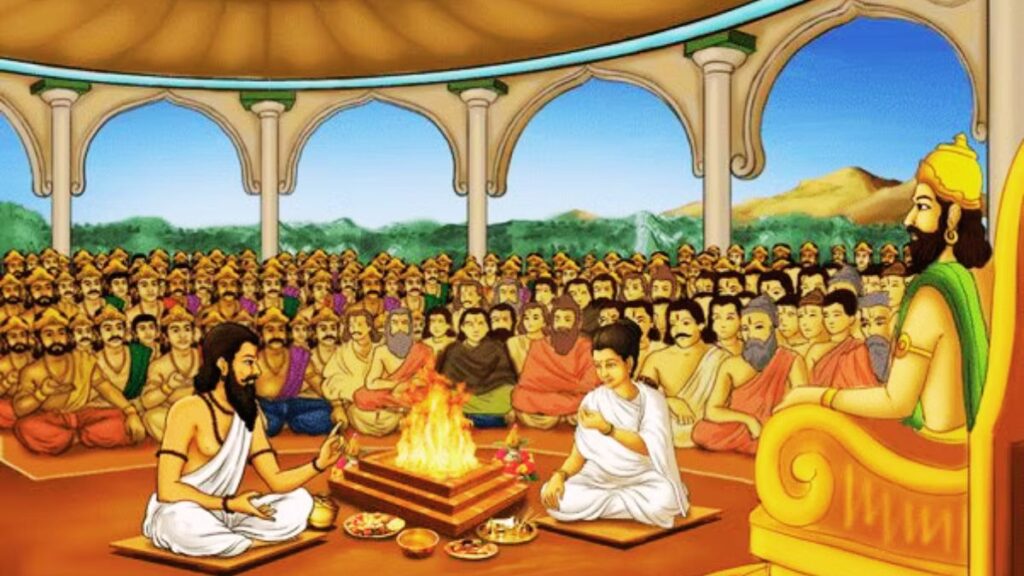
The Vedas not only emphasise religion but also focus on the lives of people during that age. We come to know about the political, social, and economic life of the people and how the societal framework worked.
Rig Veda, probably the oldest literary creation, not only in India but also in the entire Indo-European literature, highlights the simple socio-economic, political, and religious life of the people.
The Introduction of The Vedic Age:
The Vedic age is deeply connected with the Aryan people, who are believed to be the primary group that brought the culture. “Aryan” means high birth, but generally refers to language. However, some historians use this term to refer to a distinct racial group.
It is difficult to claim that all the earliest Aryans belong to the same race, but more or less, their cultures have similar characteristics.
The Boghazkoi inscription, dated 1400 BC, provides basic information about the peace treaty between the Hittites and the Mittani rulers of the Hittani. In this inscription, we also find information about the Vedic gods, such as Indra, Mitra, Nasatya, and Varuna.
After coming to India, the Aryans expanded rapidly. Historians believe that the reasons behind the rapid expansions could be:
- Chariot-driven horses,
- Weapons made of good-quality bronze,
- Use of Armour/Varman
- Use of a destructive machine called Purcharishnu.
Early Vedic Age (1500-1000 BC):
Geography:
It is confirmed by the Rig Veda that the Aryans had knowledge about the Indus Valley or the Saptasindhu. Indus is the most mentioned river in the Rig Veda, while the Saraswati river was the holiest.
Saraswati River or Naditarna is identified with the Hakra Ghaggar channel in Haryana and Rajasthan. It is believed to be the Avestan river Harakhvati, from where the name of the Saraswati River originated.
Terminologies:
Terms like samudra were mentioned in the Rig Veda, which means a collection of water, but not a sea. Other terms are: Himavat or snow mountain, Dhawa or desert land, and Majuvant (from which the Aryans got soma, an intoxicant drink).
Political Organisation:
The Rig Vedic society was predominantly a tribal polity. Kula (family) was the centre of both social and political organisations.
Starting from Kula, the hierarchy in ascending order was:
- Grama or Village
- Vis or Clan
- Jana or Tribe
- Rashtra or Country.
The tribal chief, known as Rajan or the King, was the centre of all administrative machinery. The position of the Kings or Gopajanasya was hereditary.
The Rajan was not the ruler of any specific country
Or region, but was responsible for the protection of the tribe and cattle.
Several tribal assemblies emerged during the time to assist in administration. Most prominent assemblies are:
- Vidhata
- Sabha
- Samiti.
These organisations exercised military and religious functions, and women used to attend these organisations occasionally.
The Doctrine of Divinity was not associated with kingship. Other important officers in the administrations were: Purohita, Senani, Kulapati, Vishpati, Brajpati, Gramini, Sparsa, Duta, etc.
The Das Rajana War or Battle Of Ten Kings:
In this famous battle, Sudas, the son of Divodas and the Bharata, King of the Tristu family, won over an alliance of ten tribes, five of them Aryans, and five of them were non-Aryans, and killed their leader. Purushasukta emerged as victorious and established the supremacy of the Bharata.
The battle of the ten kings was fought on the bank of the river Parushni (Ravi). The reason for the battle was the dispute between Vashistha (priest of Bharatas) and Vishvamitra (Priest of the alliance).
Other Important Facts:
- The Rig Vedic society was predominantly pastoral. The cow was the most important animal during the period. The terms of war were Gavisthi, or the search for cows.
- Cattle breeding was the main occupation during this time, and agriculture was the secondary occupation. Apart from cows, sheep, horses, dogs, etc, were domesticated. Yava or Barley was mentioned in the Rig Veda.
- Panis were the trading class. Apart from them, metal smelters, karmars, and kumaras were mentioned in the Rig Veda.
- Ochre colored pottery was very popular at that time. However, black and red ware types of pottery are also known to the people.
- Indra was the most important god during the period. He was known as Purandara, or the Breaker of forts. Apart from Indra, Varuna, Agni, and Soma were other prominent gods during the Early Vedic age.
Test Your Knowledge:
Also Read: Indus Valley Civilisation (With Free Quiz) For SSC, Railways, & Other Competitive Examinations
Also Read: Later Vedic Age (With Practice MCQs) For SSC, Railway, & Other Competitive Examinations

Hi, I am Lakshya Sen.. I have been teaching for SSC, Railways, and Other Examinations For 5+ years. To date, more than 1000 students have fulfilled their dreams with the help of my guidance.