
During the 20th century, the archaeological experts brought to light an ancient urbanised civilisation that flourished in the Indian subcontinent.
To date, more than 1,400 settlements of the Indus Valley Civilisation have been discovered. The north-south spread of this civilisation was around 1400 km, whereas the east-west spread was more than 1600 km.
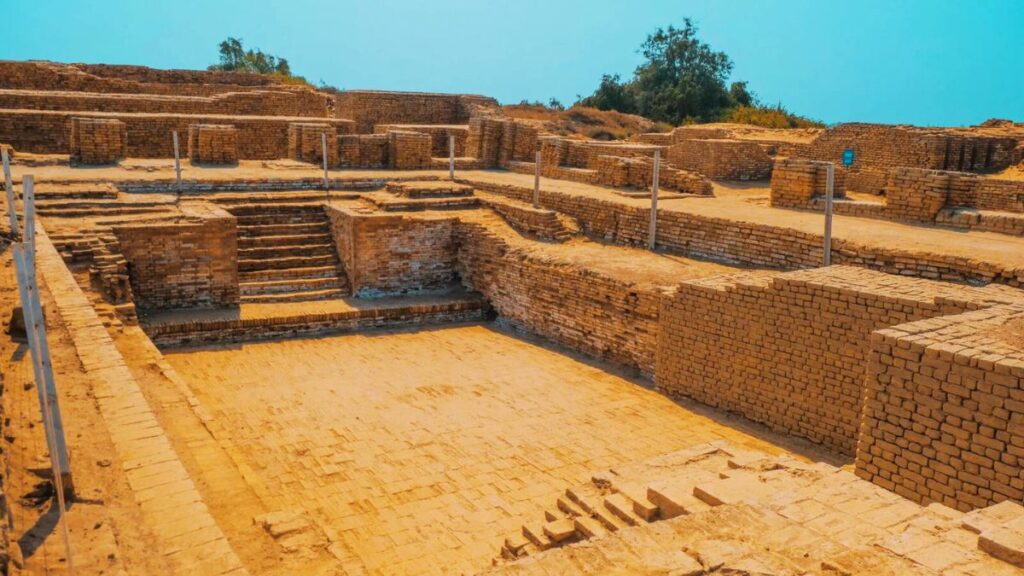
However, despite having such a large area, most of the Indus Valley Civilisation settlements were located in the valley of the Saraswati river system, which is extinct today.
The Saraswati River was known as the Ghaggar in Punjab province and the Chakra in Balochistan region.
Introduction of the Indus Valley Civilisation:
Geographical Area:
It is believed that the Indus Valley Civilisation is older than the Chalcolithic Civilisations, yet more developed than these cultures.
The Indus Valley (popularly known as Harappan) Civilisation was predominantly developed in the northwestern part of the Indian Subcontinent.
The settlements from the Indus Valley Civilisation form the central zone of the pre-Harappan culture.
The main centre for the mature Harappan culture is located in Sindh province and the Punjab region. From here, the civilisation spread along the Indus River southwards and Eastwards.
The area of the Harappan civilisation is approximately 1300000 sq km and is much more than ancient Egypt and Mesopotamia. The triangle-shaped civilisation has geographical limits from the Afghanistan border to modern-day Uttar Pradesh.
| Direction | Geographical Limit | Present Day Location |
| North | Manda | Jammu & Kashmir |
| South | Daimabad | Maharashtra |
| West | Sutkagen Dor | Pakistan |
| East | Alamgirpur | Uttar Pradesh |
Important Indus Valley Sites:
Harappa (Punjab, Pakistan):
Harappa was the first Indus Valley site that was discovered and excavated under the supervision of Daya Ram Sahani in 1921, on the bank of the river Ravi.
The Indus Valley Civilisation is also known as the Harappan Civilisation because Harappa was the first Indus Valley site to be discovered.
However, Charles Masson was the first person to report the vast mounds at Harappa in 1826, and they were visited by Cunningham in 1853 and 1873.
Six granaries were located outside the citadel but immediately next to it in the west.
Barracks or rows of single-roomed quarters are situated below the walls of the citadel. These single-roomed quarters were probably the home of labourers.
According to many historians, Harappa was the gateway of the civilisation and probably the most important city after Mohenjo-Daro.
Two types of burial practices were found in Harappa. One of them is the most common typical R37 type, and the other is an H-type cemetery.
According to the Archaeological Survey of India, Bhirrana (Haryana) is the oldest Harappan site in the Indian Subcontinent, and Rakhigarhi (Haryana) is the largest site in India.
The findings from Harappa are as follows: symbol of lingam and yoni, virgin goddess seal, wheat and barley in wooden mortar, copper scale and mirror, vanity box, dice, log chasing deer, stone sculptures of nude male and dancing female, naked male Torso (red sandstone), and some traces of Jainism.
Mohenjo-Daro:
Mohanjo-Daro is one of the biggest sites of the Harappan civilisation, discovered by R.D. Banerjee in 1922. Mohenjo-Daro was situated on the bank of the river Indus.
Mohenjo-Daro is a Sindhi word that means mound of the dead. Mohenjo-Daro is famous for various important buildings, especially the great bath.
An oblong multipillared assembly hall, a big rectangular building for administrative purposes, and the great bath, along with changing rooms, are some of the famous buildings that surprised the excavators.
Other findings from Mohenjo-Daro consist of the Pashupati seal, a bronze image of a dancing girl, cylindrical seals, a statite image of a bearded man, a clay figure of a mother goddess, dice, an idol of a yogi, and a big granary.
Other Facts About the Indus Valley Civilisation:
- Town planning was not uniform but urbanised across the Indus Valley culture. Streets were cutting each other at right angles, dividing the town into large rectangular blocks.
- The cities are divided into two parts: the upper parts, known as the citadel, and the lower parts, which are for the working class. The ruling class and administrative buildings are believed to be situated in the citadel.
- The drainage system was very impressive as every house in the city had its own courtyard and bathroom. Underground drainage system connected all houses to the drains, made of mortar, lime, and gypsum. Drains were built of burnt bricks.
- There is no clear evidence available about the political organisation of the civilisation. No temples or religious places were found anywhere. There is no evidence of religion in this culture except for the great bath. It is believed that the Harappans lacked weapons.
- Harappans used to worship the mother goddess and Pashupati Mahadeva or proto-Shiva. Numerous symbols were collected from the excavations. Harappans may believe in ghosts or evil forces.
- The Harappan economy was mainly agricultural. However, cattle rearing was their secondary occupation. Wheat, barley, ragi, jowar, bajra, mustard, peas, etc, were known to the Harappan people.
Test Your Knowledge:
Also Read: Early Vedic Age (With Free Quiz) For SSC, Railways, & Other Competitive Examinations

Hi, I am Lakshya Sen.. I have been teaching for SSC, Railways, and Other Examinations For 5+ years. To date, more than 1000 students have fulfilled their dreams with the help of my guidance.